
Organizations are investing heavily in AI—deploying the latest LLMs, implementing sophisticated RAG systems, building agents with MCP tools. Yet a surprising number of AI projects struggle to reach production or fail outright. The issue is rarely technology—it’s a disconnect from business context.
Of course, this is a familiar story. The same pattern played out in the Big Data era and every epoch before. The search for miracles is never-ending. As we transition from alchemy to chemistry, we need to help leaders reframe expectations: business success requires building on a strong foundation—a shared understanding of existing business objectives, systems, organizations, and data, much of which may already be captured in existing tools.
In the haste to adopt AI, organizations focus on what can be built quickly rather than what delivers business value. Building for value requires more planning, preparation, and collaboration across teams applying their expertise, extending existing tools, and capturing this foundation.
AI teams often operate without understanding organizational structure, the objectives that should guide data selection, user needs, or which systems are authoritative for specific purposes. There is often a lack of clarity around the processes the AI must support, and which systems are current or deprecated for particular purposes. This understanding should guide everything—which data to prioritize for training, how to construct RAG sources, which MCP tools to build and when agents should use them. Without this grounding, teams make technically sound decisions that miss business reality.
Of course, business context isn’t static. Objectives shift, organizations evolve. Successful projects establish this foundation at the start, accommodate changes as they occur, and use it throughout—from preparation to ongoing operations.
The AI Application Journey
In our previous blog, we introduced how Context Intelligence improves AI application development and operations. To explore this further, we present a framework describing the natural progression of AI projects—not a prescriptive methodology, but a view centered on how organizational understanding flows and evolves.
Each phase requires understanding and applying this foundation: What matters to the organization? Who are we serving and what are their needs? What capabilities exist in terms of systems, processes, and data? What are the requirements and scope? How do we measure success?
These questions aren’t unique to AI—they’re grounded in industry best practices. But AI projects often ignore them in the rush to deploy. However, as we dive into the different phases we will look more specifically at AI projects as well as general principles that shouldn’t be ignored just because this is an AI project. For example, the principle of evolution. As business needs evolve, so must the project. As we plan and execute, we continue to discover, learn, and evolve scope and objectives. Accommodating this evolution is a core design principle.
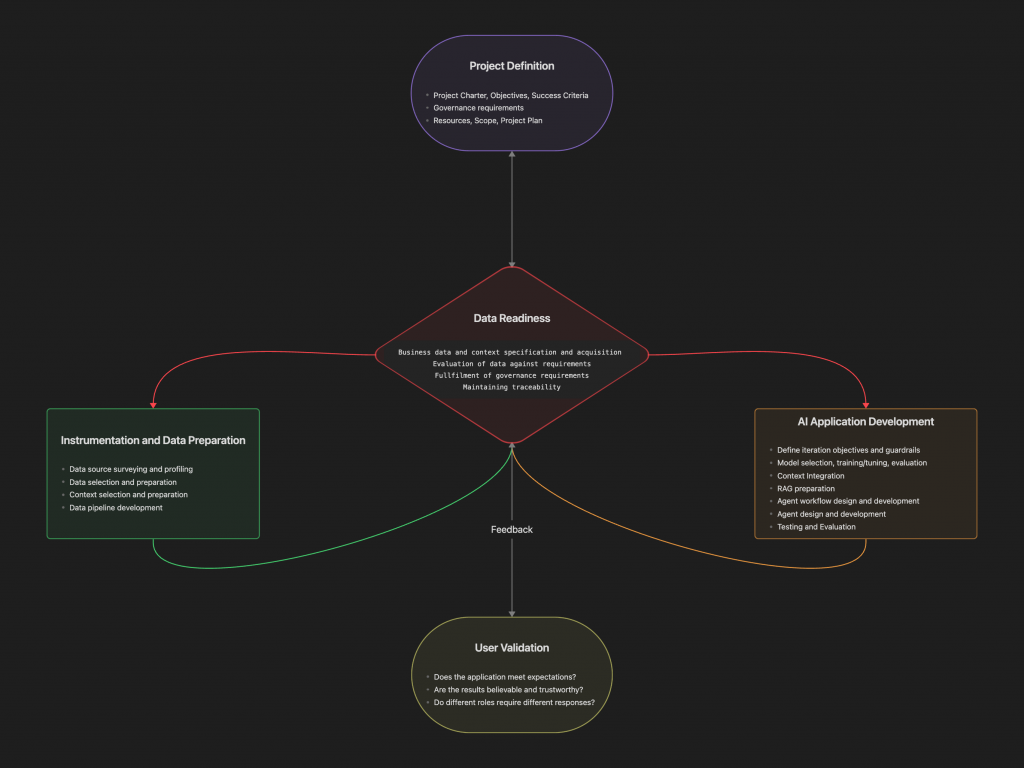
Project Definition establishes the foundation—the problem, objectives, stakeholders, and success criteria. Which business capabilities are in scope? How does the organization actually make decisions?
In Data Readiness, you apply this understanding to assess data sources. Which systems are authoritative for what purposes? What reflects current priorities versus historical artifacts? How do licensing, privacy, and quality align with objectives? My colleague, Mandy Chessell discusses this further in her article on Data Readiness for AI at https://www.linkedin.com/pulse/data-readiness-ai-mandy-chessell-uyome.
AI Application Development puts this knowledge to work. The best sources for training or tuning LLM models become clear. MCP tools can be matched to business roles. RAG sources reflect current knowledge. The AI can respond appropriately to different organizational contexts.
Instrumentation and Data Preparation addresses provisioning the selected data for use by the applications and then observing the reality of its use. Is the data that we have selected appropriate? Is it of acceptable quality? Are the right metrics in place to ascertain the alignment of what the applications are delivering with user and business needs?
User Validation closes the loop. Does the AI support actual decision-making patterns? Do different roles get appropriate responses? Are security and privacy appropriate? What feedback patterns reveal context gaps? Is the system useful? Should business processes or objectives be reviewed?
Why Business Context Matters
Most AI initiatives start with technology, not business context. Teams jump to data selection without understanding business priorities. Development happens without organizational clarity. The result: technically sound solutions that don’t fit business reality.
When business context is missing, problems compound. Consider a data science team selecting historical sales data for forecasting. They don’t know the business restructured regions two years ago or that System C is now archival only. The model learns outdated patterns. In production, forecasts don’t align with current objectives. Regional managers lose trust because answers don’t match their reality.
Or a development team building MCP tools without knowing which systems are authoritative for which purposes, or that European operations use different systems than North American. The agent chooses based on availability, not appropriateness. A Paris sales manager gets New York data. Technically correct, contextually wrong.
Users report the AI doesn’t understand their priorities. Feedback stays siloed. No one connects it to missing business context. The development team doesn’t learn which capabilities matter. Business objectives shift but the AI never adapts. The gap grows.
Context Intelligence addresses this by maintaining an enterprise knowledge graph capturing organizations, roles, business objectives, capabilities, processes, data assets, systems and their authority, quality, licensing, and privacy—in both business and technical terms. It provides continuity across technical phases and accommodates change as business context evolves.
Business objectives change, organizations restructure, priorities shift. Context Intelligence allows AI systems to evolve with the business. New context flows through to existing systems. It’s living infrastructure that grows with your organization.
A Sales Forecasting Example
Consider a company building an AI assistant for sales forecasting after merging with a European competitor and restructuring regional sales. The objective: unified forecasting across all regions. Technically straightforward, but the organizational context is complex.
Without this foundation, training data includes pre-merger structures. The AI doesn’t understand current boundaries. MCP tools don’t know which systems serve which purposes. European managers get North American data. Forecasts don’t align with objectives or organizational reality. The executive dashboard shows technically correct but businesswise meaningless numbers.
With Context Intelligence, Project Definition captures current structure and objectives. Data Readiness identifies which systems are authoritative for which regions. Development builds MCP tools characterized by business purpose. Instrumentation tracks how different roles use the AI. User Validation reveals where understanding needs refinement. When objectives shift—say, focusing on a new product line—context flows through to update behavior. The result: AI that evolves with the business.
Why This Matters
When organizational understanding flows through the AI journey, you gain tangible benefits: time to value through decisions grounded in reality from the start, reduced risk because AI fits organizational context rather than fighting it, sustainable systems that evolve with business change instead of becoming obsolete, and true business alignment where technology serves actual objectives.
This isn’t about capturing a snapshot and freezing it. Organizations evolve: objectives shift, structures change, priorities refine. Context Intelligence accommodates these changes, allowing AI systems to adapt without complete rebuilds. It’s living infrastructure that grows with your organization.
Over the next several blogs, we’ll explore each phase in detail: how to establish and apply this foundation, critical questions about scope and organizational fit, how Context Intelligence maintains and evolves understanding, and practical examples from our sales forecasting scenario.
Our next blog dives into Project Definition—how to establish organizational context at the start, understand objectives and stakeholders, define scope in business terms, and how Context Intelligence captures this foundation for the entire journey.
Every successful AI journey begins not with choosing a model or selecting data, but with understanding the business context that should guide every decision along the way.